Equipment · Reviewed 2026-11-01
Enshrouded armor upgrades: runes, rarity and crafting survivors
Find the survivor who upgrades your armor, understand what rarity changes and compare affordable perks before spending runes on a replacement.
Check the next upgrade before changing gear
- Warrior equipment
- Blacksmith
- Ranger equipment
- Huntress
- Mage equipment
- Alchemist
- Recipe progression
- Flame upgrades unlock the next armor tier
Start with the piece you already wear. Read the next upgrade and its cost, then compare a replacement at the upgrade state you can actually afford.
Go to the survivor for your equipment class
Take the item to the crafting survivor who handles its class. Use the Blacksmith for warrior equipment, Huntress for ranger equipment and Alchemist for mage equipment. Armor, shields, wards and rings are upgradeable under the equipment system.
At the upgrade screen, check the next perk, protection values and required currency before confirming. A new piece may need several upgrades before it can replace the one you are wearing. Keep both until you have compared that cost.
Sources: Keen Games: Forging the Path
Separate rarity from the stats you can use
The equipment update separates an item’s base stats from its quality. Rarity determines how much upgrade space it has. Most crafted armor starts at Rare; loot armor can reach Legendary. A better rarity label alone does not settle which piece you should equip.
For your next trip, compare the current protection and the perks you will actually use. Then look at the higher-rarity item’s remaining upgrades as a separate spending decision. A replacement can stay in storage while you gather the runes to finish it.
| Check | What it tells you | Decision to make |
|---|---|---|
| Current item and upgrade state | The protection and perks available now. | Can the replacement do its job before another upgrade? |
| Remaining upgrade steps | The room for later improvement. | Is the next useful perk worth the currency it needs? |
| Skill-related perk | Which learned skill the item improves. | Do you use that skill, or would the perk be idle? |
| Physical and magical armor | The protection each piece provides. | Which type of incoming damage needs attention? |
Sources: Keen Games: Forging the Path
Check Flame progression when a recipe is missing
In 1.0, each Flame upgrade unlocks armor for the following crafting tier. If an old guide sends you searching for an unlock material, first check your Flame progress and the appropriate survivor’s current recipes.
Some named sets also changed how they are obtained. Marksman now comes from Revelwood loot chests and Sharpshooter from Nomad Highlands loot chests. Each of those tiers has separate craftable ranged and dagger armor. Use a current crafted set while searching for a particular drop.
For a missing crafting ingredient, open the material’s description. The equipment update added acquisition hints for most resources; common resources found widely in the world can be exceptions. Read that hint before committing to a gathering trip.
Sources: Keen Games: 1.0 release changelog · Keen Games: Forging the Path
Keep a rune budget for the equipment you still need
Write down the cost of the next useful upgrade on your weapon and on the armor piece you want to improve. If damage is adequate but you cannot survive a short exchange, protection deserves a comparison before another damage purchase. If an unused skill perk is the only gain, leave that upgrade for later.
Unneeded armor, shields, wards and rings can be recycled into runes. Keep your current loadout and anything needed for the comparison until you have made the decision. Version 1.0 moved the point at which Legendary items require Legendary runes one step later. Read the next cost on the item instead of assuming every remaining step uses ordinary runes.
Sources: Keen Games: Forging the Path · Keen Games: 1.0 release changelog
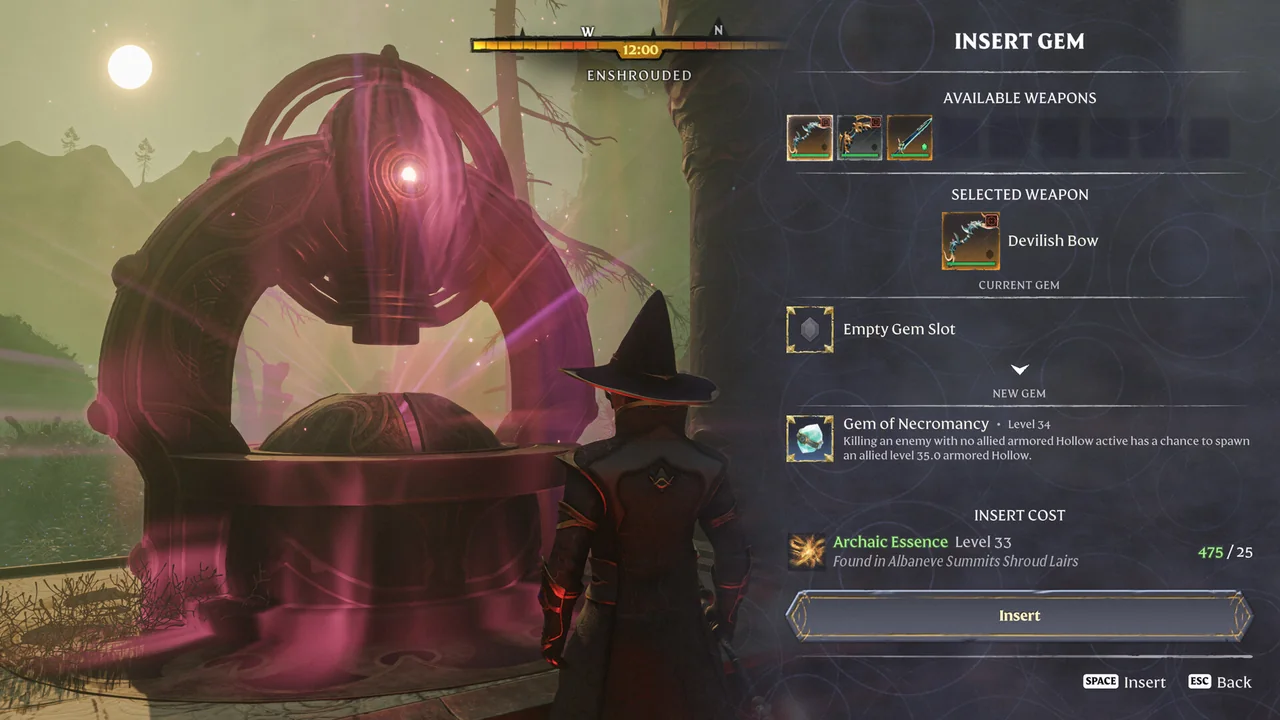
Use the Gem Forge for a separate weapon decision
A weapon gem and an armor upgrade are separate purchases. Inspect a gem’s effect, insertion or extraction requirements, and the weapon you intend to keep. Do not treat a gem-station screen as the place to upgrade every armor piece.
The 1.0 release allows a Gem Forge station at the player base later in progression. You can still plan an upgrade budget before that unlock. Use the relevant combat survivor for class equipment and return to the gem choice when the weapon and required resources are ready.
Sources: Keen Games: 1.0 release changelog · Keen Games: Wake of the Water
Read level caps as limits, not a shopping list
The 1.0 release raises the player cap to 50 and the equipment upgrade cap to 55. Those are overall ceilings. They do not mean a new character can obtain or afford level-55 equipment.
Follow the tier your world and survivor recipes currently support. Improve a usable set for the next area, then revisit the comparison when another Flame upgrade or a suitable drop changes your options.
Sources: Keen Games: 1.0 release changelog
Build questions
Can I upgrade armor instead of waiting for a Legendary drop?
Yes. The equipment system supports armor upgrades, and most crafted armor starts at Rare. Compare its available protection and perks with what you can afford on a drop.
Sources: Keen Games: Forging the Path
Does an item perk buy a skill I have not learned?
The cited equipment system describes perks that raise an already learned skill, including beyond its point-funded level. Check that you have the skill before valuing the perk.
Sources: Keen Games: Forging the Path